On generative AI, art, and the difference between being able to and wanting to. With a list of defects up front, a urinal in the middle and a fridge at the end.
First, the list of defects
Let’s get the unpleasant part out of the way first. Then it’s done.
It eats electricity. Generative AI runs in data centres so thirsty that tech giants are now locking in the output of entire nuclear power plants. So somewhere right now a cooling system is humming so you can have a cat in a spacesuit. In four variations. The third one is quite pretty.
It costs jobs. And first of all where hardly anyone was ever on a permanent contract anyway: in translation, illustration, copywriting, dubbing. Freelancers always notice these things first.
It plays fast and loose with data. With yours, the data you entrust to it in weak moments. And with the images, texts and songs of millions of creatives it learned from, without anyone ever having been asked.
It makes a few companies very powerful. How the tools everyone will soon be working with think is decided in a handful of conference rooms, most of them in California.
And it may well be too cheap. The industry burned money for years, and OpenAI still does, billions of it, quarter after quarter. Whether the twenty-odd euros for a monthly subscription is a fair price or a loss leader, nobody really knows. Anyone who lived through the early years of Uber or the streaming services knows the pattern: first cheap, then indispensable, then expensive.
All justified. All important.
The genie, the bottle and a simple question
The thing is: the genie is out of the bottle, and it isn’t going back in, however nicely we ask. We can curse it, or we can give it house rules. I’m for the second. Laws, standards, labelling requirements, fair pay for everyone whose work is sitting in the training data. The EU has made a start with the AI Act, and it won’t have been the last paragraph.
That is the big political building site. Alongside it, there’s a question that nags at me, one that sounds smaller and is in fact bigger: does AI actually replace art?
I don’t just mean art in the sense of museum, plinth, twelve euros admission. I mean everything where people shape something that is meant to touch other people. A picture, a text, a song, a poster. An invitation to a garden party. Can the machine do that? And if it can: what is left for us?
A paintbrush with autocomplete
The comforting answer first: AI is a tool. A fairly powerful one, granted, but still one that somebody has to operate. And as with any tool, what it can do only shows in the hand that holds it.
Anyone who has ever tried to wring exactly the picture they had in mind out of an image generator knows: that is work. You have to know what you want, how to describe it and what to throw out again. You need an eye for composition, for light, for typography. If you have that, you can do astonishing things with AI. If you don’t, you do with AI what you used to do with WordArt: something very loud that says nothing.
None of this is new, by the way. When photography came along, Charles Baudelaire complained in 1859 that it was the refuge of every painter who lacked talent or diligence. Painting survived that. More than that: because the camera relieved it of the duty to depict the world as faithfully as possible, it became free for Impressionism, Expressionism, abstraction. Maybe something similar is happening right now. Maybe AI is relieving art of the duty to merely look good.
And let’s be honest: there was rubbish before, too. Plenty of it. Stock photos of people laughing alone over a salad. Club flyers from the template gallery. Hotel room art in beige. Pop songs off the conveyor belt, cleanly produced and forgotten after three weeks. A lot of it was decently made and still completely soulless. AI didn’t invent mediocrity. It only industrialised it.
Knowing everything, wanting nothing
So what separates the people who do it better from the machine? A good artist, a good designer draws on a huge pool: art history, design trends, the films you saw at sixteen, the smell of your grandfather’s workshop. Out of that, something new emerges. AI has a far bigger pool, basically everything that has ever been digitised. Shouldn’t it be the better artist, then?
I think the difference lies not in how much you know but in what you do with it. An image generator is, roughly speaking, a machine for the probable. It delivers whatever most plausibly follows from your request. Art, on the other hand, is often the improbable that seems inevitable afterwards.
People know less, but they know it differently. With the body, with their own history, with scars. They have a reason why they have to paint this particular picture and no other. And they have taste. Taste is, at its core, a long list of things you don’t do. AI knows all the options. A person rejects most of them. That rejecting is where the handwriting lives.
Which brings us to inspiration. For research, AI is a gift: a moodboard in seconds, twenty variations to find out what you definitely don’t want, references from eras you’ve never heard of. That can widen your horizon enormously.
It can also narrow it. Because the first idea is usually the idea everyone has. You used to have to draw your way through your own mediocre ideas to eventually arrive at the good ones. The blank page was uncomfortable, but it was a resistance you could grow against. Today the mediocre ideas arrive fully rendered, and they look so good that you forget they’re mediocre. You stop before you’ve properly started. Not because the result is good, but because it looks good enough.
That’s just how pictures look now
You know them, these invitations. To the summer party, the company anniversary, the reading at the public library. A sunset more golden than any sunset has ever been. Glasses sparkling as if someone had polished them specially for this moment. Fairy lights melting softly into the background. Faces with the skin of porcelain dolls. You used to be able to spot these pictures by counting fingers, quite literally: someone always had six. The machine has since learned to count.
I still recognise these pictures instantly. By that gloss, that smoothness, that too-much of everything. But I also notice something shifting. I don’t flinch any more. I accept them the way you accept lift music. That’s just how pictures look now.
And that’s exactly where it starts to creep me out. Not because of the machine, but because of the getting used to it. Perception is trainable, and not only in AI. Eat nothing but frozen pizza for years and at some point you’ll take the charred edge of a real wood-fired pizza for a mistake. Hear nothing but autotuned voices and an unpolished one suddenly sounds off-key.
The flood of images doesn’t just change what we see. It changes what we consider normal, what we consider good and, in the end, what we want. Because we want what we know. And we know what we’re shown.
The hunger for the rough
What does that do to our hunger for the personal, the rough, the soulful? Two scenarios suggest themselves.
In the first, we go numb. The human touch becomes nostalgia, like handwriting or postage stamps: nice, but somehow a hassle.
In the second, it becomes more precious than ever. There’s a fair amount pointing that way. When music turned into a data stream, the vinyl record came back. When bread started coming out of factories, sourdough bakeries became places of pilgrimage. And a generation that grew up with smartphone cameras is buying rolls of film again. The smoother the world, the greater the longing for something with some friction to it.
My money is on the second scenario. But it has a catch. Two, to be precise.
The first: the machine learns that too. You can already tell it to please make the picture a bit crooked, with brush marks, a coffee stain and a pinch of imperfection. The human touch will soon be available as a filter. But if roughness can be simulated, it no longer proves anything. Then the value moves from the work to the person behind it. To the questions: who made this? Can I watch them do it? Can I trust this person? Art then becomes a little more relationship and a little less commodity.
The second catch is economic. Many people will settle for the generated stuff, and not even wrongly. For the birthday poster, the club flyer, the illustration in the company blog, it’s enough. Which in turn means: only a few people will be able to make a living from human artistic work.
You could object that it was always like that. True. But until now there was a broad middle: commercial graphics, commissioned illustration, the logo for the bakery around the corner. Those bread-and-butter jobs paid the rent, and on the side they were the training ground where people got good in the first place. It’s exactly this middle that is crumbling now. The top will still exist. But who is supposed to get there once the way up falls away?
And so the human touch may become what it has often been throughout history: a luxury. The drawn portrait, the novel written by a human, the hand-set poster as a status symbol for everyone who can afford it and wants to notice the difference. Pierre Bourdieu would have found plenty of material for a sequel to his “Distinction”.
Making it and placing it
Right now there’s a lot of arguing about whether AI could take on a life of its own and wipe out humanity. I suggest we shift down a few gears and ask something more modest: can an AI independently create something genuinely artistic? Or does it take at least one human to take the result, place it in front of us and say: this is art.
In 1917 Marcel Duchamp submitted an ordinary urinal to an exhibition in New York, tipped ninety degrees and signed “R. Mutt”. He hadn’t made it. He had only chosen it, turned it over and given it a title: Fountain. Since then we have known that art doesn’t necessarily happen in the making. Sometimes it happens in the placing.
Making is something AI can do, at a pace and in quantities that make any art academy look like a sleepy workshop. But placing? Choosing, asserting, meaning something? That takes someone who wants to say something. The machine delivers when asked. It doesn’t wake up at night because a picture won’t let it rest. It has no theme that has haunted it since childhood. As far as we know, it couldn’t care less whether anyone looks.
Although that “as far as we know” is doing a lot of work. Whether there will ever be somebody inside these systems who means something, not even the people building them can say. Maybe the day will come when an AI makes a picture and places it of its own accord. Then we’ll have to think again. Until then, the choosing and asserting, this “this one!”, remains the actual artistic act. That goes for everyone who fishes exactly the one out of five hundred generated variations, by the way. Duchamp would probably have nodded at them.
And then art needs a second person: the one for whom it means something. A work that touches nobody is just an object.
Maybe that’s the more interesting question in the end. Not whether the machine will one day learn to want something. But whether we will have unlearned it by then.
Postscript from the kitchen
That summer party invitation, by the way, the one with the golden sunset: after two seconds, nobody looked at it again. It was flawless, after all.
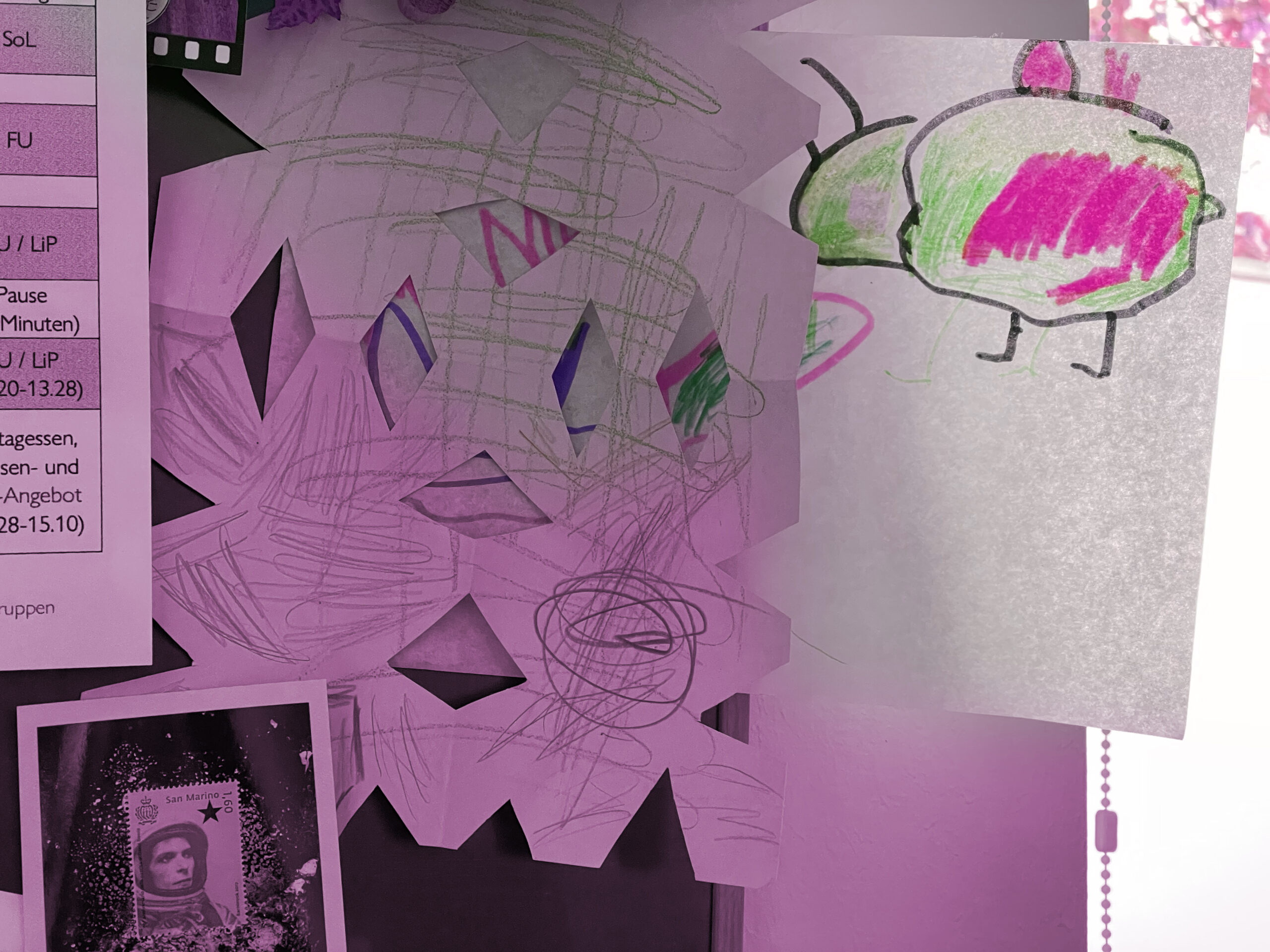
Now think of the fridges of this country. Of all the sheets of paper clamped under magnets there, some of them for years. A sun with a face. A house with a crooked chimney. A figure whose arms grow straight out of its head. Technically a disaster. No image generator in the world would arrive at that solution, it’s far too improbable. And nobody, really nobody, would trade such a sheet for the most perfect picture in the world.
Maybe that’s the answer to the question of how elitist the human touch is going to get. On the art market, possibly very. On the fridge, not at all.
Can AI replace art? I don’t know. I only know that nobody has ever hung a picture on the fridge because it was well made.